The Carrier Bag
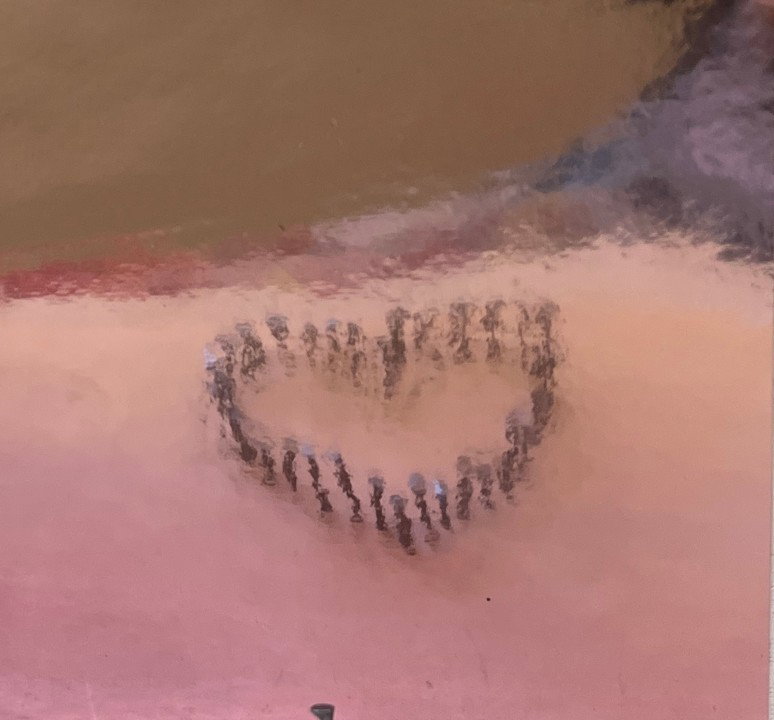
What do we carry—and what do we keep to ourselves?
As part of this project, we had to select an item from the V&A East Storehouse. I chose a bag, BOTTLETOP’s Bellani crossbody bag, and somehow, I came back with emotional baggage.
The shine from the metal ring pulls caught my attention, and I was interested in how these small, everyday objects had been joined together to make a fashion bag.
A bag carries and protects our belongings. In this case, it's metal exterior becomes a kind of armour, keeping what it holds inside private.
A bag carries our belongings, but what else do we carry around with us?
Looking, mapping and making connections
During the trip to the V& A East Storehouse, five objects caught my eye, including the Bellani bag, Ripe and Ready, the steel drum bin, Touch Form and the Farmer mannequin.
I then studied their materials, shapes, patterns, textures, composition, origins and colours, looking for possible connections.
My instinct (something I’ve learnt not to ignore) told me to go for the bag. My mapping included metal, leather, silver, loops, curves, openings and repetition. Beyond its physical qualities, I also explored ideas about identity, privacy, memories and belonging.
The challenge was making the connections believable without being too literal by simply making, painting, or drawing another bag in various media. I wanted to push the idea further and see where these different angles could take me.
From the bag to the body
As a starting point, I drew a number of features such as the ring pulls, focusing on their curved forms. Some sketches became more abstract; others evolved into bodies, shells and armour.
The opening of a bag could be a doorway to something hidden, even perhaps someone's vulnerability, whilst its shell could become a protective surface, with their curved shape sheltering something inside.
The Uganda connection in my BOTTLETOP research led me to look into African art, including Zimbabwean Shona stone sculpture. I liked the curved, simplified human forms and how a posture could suggest emotion without detailed features. I also looked into nature like fern curls, seed pods, shells, and works by Barbara Hepworth and Henry Moore. The references helped me investigate the relationship between an outer surface and an inner space. A bag is a container that carries and protects our essentials and belongings. So what if the body was a container for our thoughts, memories, feelings, and secrets?
Experiment 1: What We Hold Inside
Inspired by Zimbabwean Shona stone sculpture, I used air dry clay for my first 3D experiment to build an abstract body with a bowed head and an opening through the form. The early stages were tough with a lot of adding, removing, and smoothing. A drawing is considerably more cooperative than a lump of clay, especially when the clay is old. Photographing the piece 'sur toutes ses coutures' (from every angle) certainly helped me see where the curves and shapes felt too bulky and uneven.
I then added the metal eyelets around the opening with wire across the gap. Echoing the bag’s ring pulls, the metal could be about protecting the figure, holding it together or keeping something confined. The bowed head and curved body suggested vulnerability and a need for self-protection.
Like most of my work, the piece comes from a personal place. It is about the effort of appearing strong while feeling fragile, a duality I have often struggled with in the past.
We choose what we show other people, but how much can we keep inside?
Museum objects and initial mapping
• Victoria and Albert Museum (n.d.-a) ‘Bellani Crossbody’ bag. Designed by BOTTLETOP, 2020. Available at: https://collections.vam.ac.uk/item/O1522446/bellani-crossbody-bag-bag-bottletop/ (Accessed: 16 November 2026).
• Victoria and Albert Museum (n.d.-b) Ripe and Ready. Wall hanging by Sanaa Gateja, 2023. Available at: https://collections.vam.ac.uk/item/O1748326/ripe-and-ready-wall-hanging-sanaa-gateja/ (Accessed: 16 November 2026).
• Victoria and Albert Museum (n.d.-c) Robin Hood Gardens façade. Available at: https://lookup.vam.ac.uk/east-storehouse/storagedisplays/USE2224/ (Accessed: 16 November 2026).
• Victoria and Albert Museum (n.d.-d) Steel drum bin. Glastonbury Festival, 2014. Available at: https://collections.vam.ac.uk/item/O1544537/steel-drum-bin-glastonbury-festival-bin/ (Accessed: 16 November 2026).
• Victoria and Albert Museum (n.d.-e) Textiles at the V&A. Includes ‘Combed Paper’, NUNO Corporation, 1997, museum number T.118:36-1998. Available at: https://lookup.vam.ac.uk/east-storehouse/storagedisplays/USE2193/ (Accessed: 16 November 2026).
• Victoria and Albert Museum (n.d.-f) Touch. Artwork by Kirstie Rea, 2002. Available at: https://collections.vam.ac.uk/item/O97688/touch-form-rea-kirstie/ (Accessed: 16 November 2026).
• Dedman, R. (2026) ‘This just in: New acquisition’, Victoria and Albert Museum, February. Discusses Yasmine El Meleegy’s Farmer, Port of Alexandria (2025). Available at: https://lookup.vam.ac.uk/east-storehouse/storagedisplays/USE8068/ (Accessed: 16 November 2026).
BOTTLETOP, Uganda and sculpture research
• BOTTLETOP (n.d.) About BOTTLETOP. Available at: https://bottletop.org/pages/about (Accessed: 18 November 2026).
• Science Museum Group (n.d.) Woven grass basket. Museum number A301629. Available at: https://collection.sciencemuseumgroup.org.uk/objects/co105423/woven-grass-basket (Accessed: 18 November 2026).
• UNESCO (n.d.) Barkcloth making in Uganda. Available at: https://ich.unesco.org/en/RL/barkcloth-making-in-uganda-00139 (Accessed: 18 November 2026).
• Reid, A. and Ashley, C.Z. (2008) ‘A context for the Luzira Head’, Antiquity, 82(315), pp. 99–112. Available at: https://doi.org/10.1017/S0003598X00096472.
• SFO Museum (n.d.) Stone sculpture of Zimbabwe. Available at: https://www.sfomuseum.org/exhibitions/stone-sculpture-zimbabwe (Accessed: 18 November 2026).
• Royal Collection Trust (n.d.) Man. Sculpture by Joram Mariga, collection number 94655. Available at: https://www.rct.uk/collection/94655 (Accessed: 18 November 2026).
• The Luzira article should be credited to Reid and Ashley, rather than Cambridge University as its author. Cambridge Core
• Choto, F. (no date) Family Unity [Opal stone sculpture]. Available at: africanartisans.co.uk (Accessed: 19 November 2026).
• Kufa, M. (2026) Curiosity [Leopard rock sculpture]. Available at: etsy.com (Accessed: 19 November 2026).
• Mamvura, E. (2026) Eternal Bond [Springstone sculpture]. Available at: etsy.com (Accessed: 19 November 2026).
• Mukomberanwa, N. (no date) Wave [Springstone sculpture]. Available at: hemingwaygallery.nyc (Accessed: 19 November 2026).
Material experiments
• AQA (n.d.) Producing a wire and papier mache sculpture: Unit 2. Unit Award Scheme, unit 81528. Available at: https://www.aqa.org.uk/programmes/unit-award-scheme/unit-details?unit=81528 (Accessed: 18 November 2026).
• Crayola (n.d.-a) Do you have any tips for decorating Air-Dry Clay? Available at: https://www.crayola.com/en-gb/faqs/do-you-have-any-tips-for-decorating-air-dry-clay-faq (Accessed: 18 November 2026).
• Crayola (n.d.-b) Why has my Air-Dry Clay piece cracked? Available at: https://www.crayola.com/en-gb/faqs/why-has-my-air-dry-clay-piece-cracked-faq (Accessed: 18 November 2026).
• The Heckscher Museum of Art (2020) H@H Kids Edition (Episode 1): Abstract & realistic foil sculptures, 25 March. Available at: https://www.heckscher.org/heckscher-at-home-sculpting-with-foil/ (Accessed: 18 November 2026).
• Mitchell, C.J. (1992) Mineralogical characterisation and processing of some industrial minerals from Uganda. Report WG/92/011. Nottingham: British Geological Survey. Available at: https://nora.nerc.ac.uk/id/eprint/20647/ (Accessed: 18 November 2026).Chidhakwa, M. (2026) Abstract Sculpture, Stone Sculpture, Contemporary Art, Shona Art Zimbabwe, Creation in Serpentine Stone, Home Deco [Leopard rock sculpture]. Available at: etsy.com (Accessed: 19 November 2026).
Design inspirations• Project Janszoon (n.d.) About the Abel Tasman National Park. Available at: https://www.janszoon.org/abel-tasman-national-park/ (Accessed: 19 November 2026).
• NC State Extension (n.d.) Magnolia × soulangeana. Available at: https://plants.ces.ncsu.edu/plants/magnolia-x-soulangeana/ (Accessed: 19 November 2026).
• Runck, A. (2026) Chambered Nautilus. Australian Museum. Available at: https://australian.museum/learn/animals/molluscs/chambered-nautilus/ (Accessed: 19 November 2026).
• Barbara Hepworth (n.d.) Pelagos. Available at: https://barbarahepworth.org.uk/sculptures/1946/pelagos/ (Accessed: 19 November 2026).
• National Galleries of Scotland (n.d.) The Helmet by Henry Moore. Available at: https://www.nationalgalleries.org/art-and-artists/8723/helmet-1939-1940 (Accessed: 19 November 2026).