Space Invader
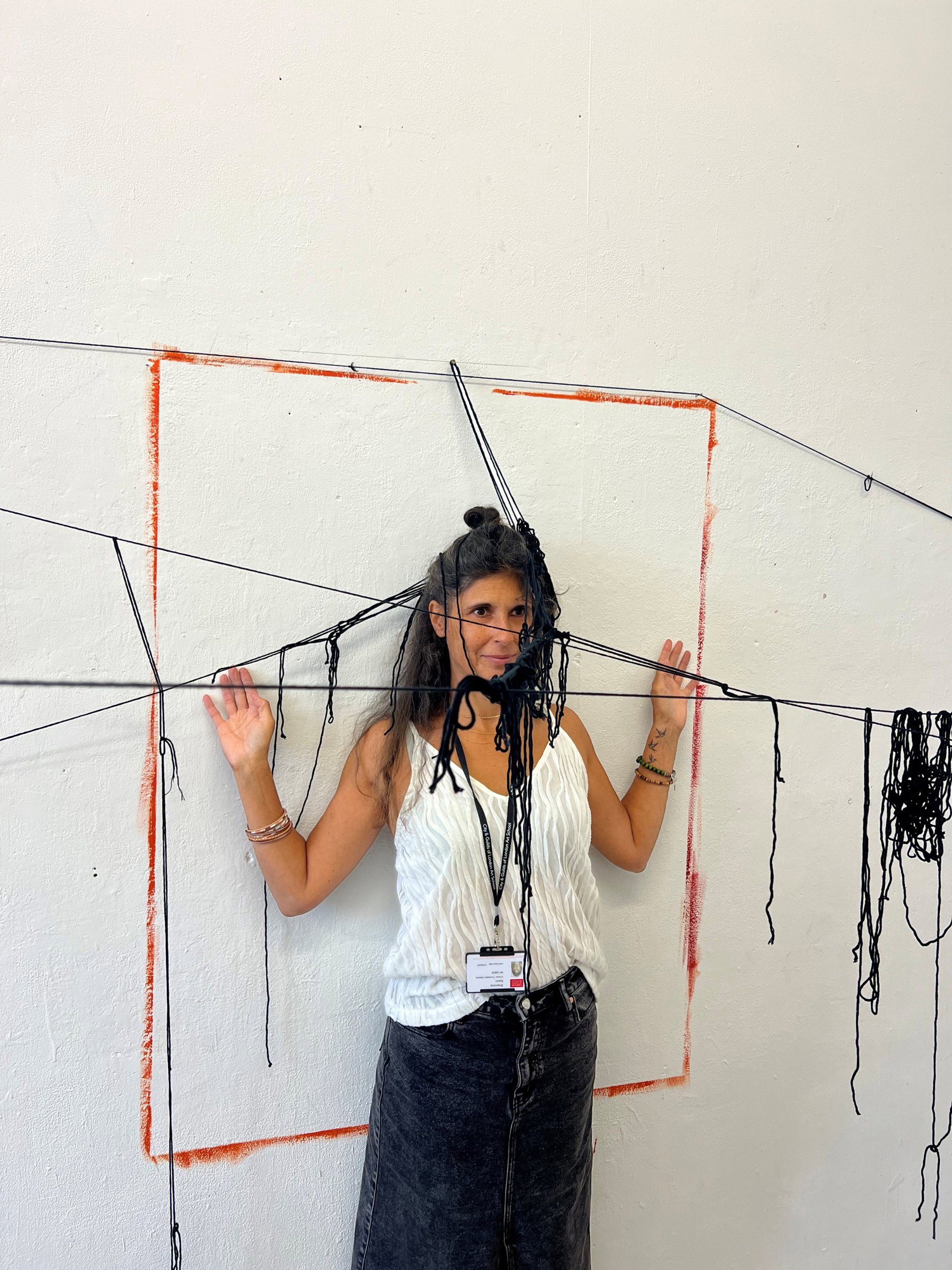
Our first project was about taking drawing away from the page and thinking about how a line could exist in a space.
We started with a series of quick drawing exercises before working together to create an installation using black wool and the studio itself.
The day was about experimenting and reacting to what was happening and allowing the work to change as we went along.
RESEARCH
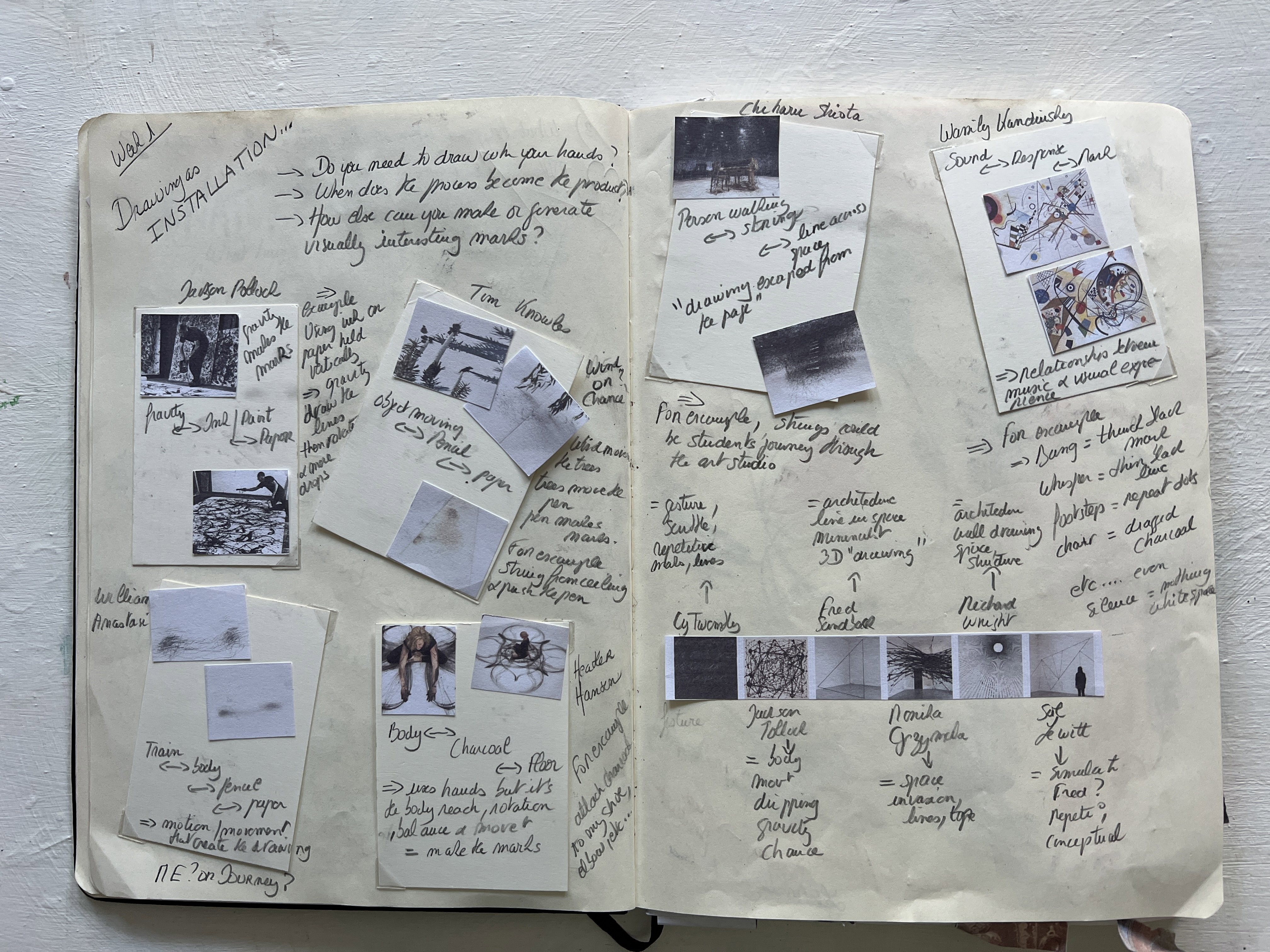
Before starting the practical work, I researched artists from the project brief who challenged traditional ideas of drawing and explored line, movement and space. Looking at their work helped me understand how drawing could move beyond the page before experimenting with these ideas myself.
EXPERIMENTATION & DEVELOPMENT
What did I enjoy?
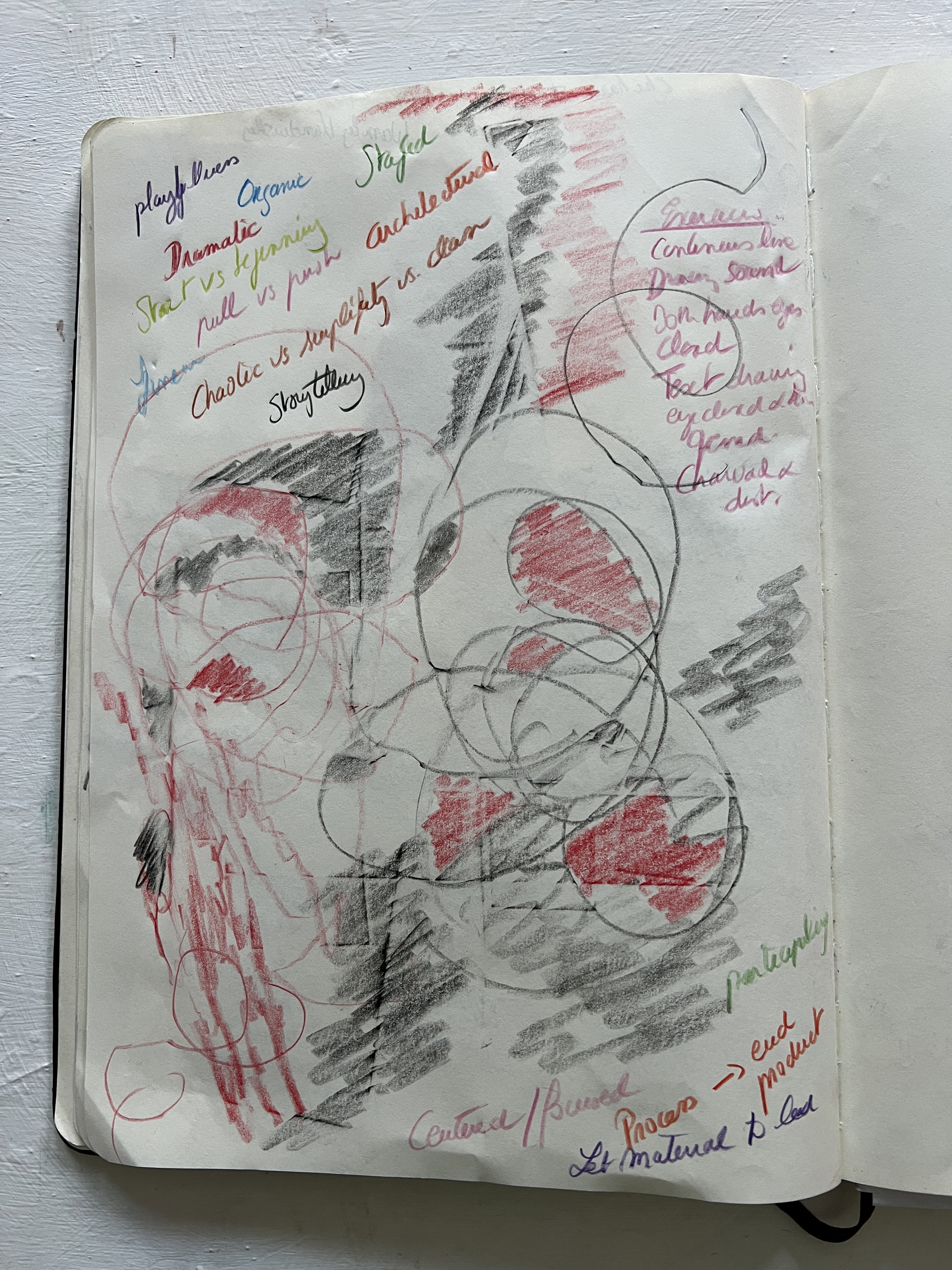
I enjoyed how the project made me look at the idea of ‘drawing’ in a less conventional way. It was playful and gave me a different perspective on what a drawing can be. It was interesting to broaden my thinking, letting go of the idea of making something look ‘right’, seeing what could happen through movement, chance and experimentation.
Group installation exercise
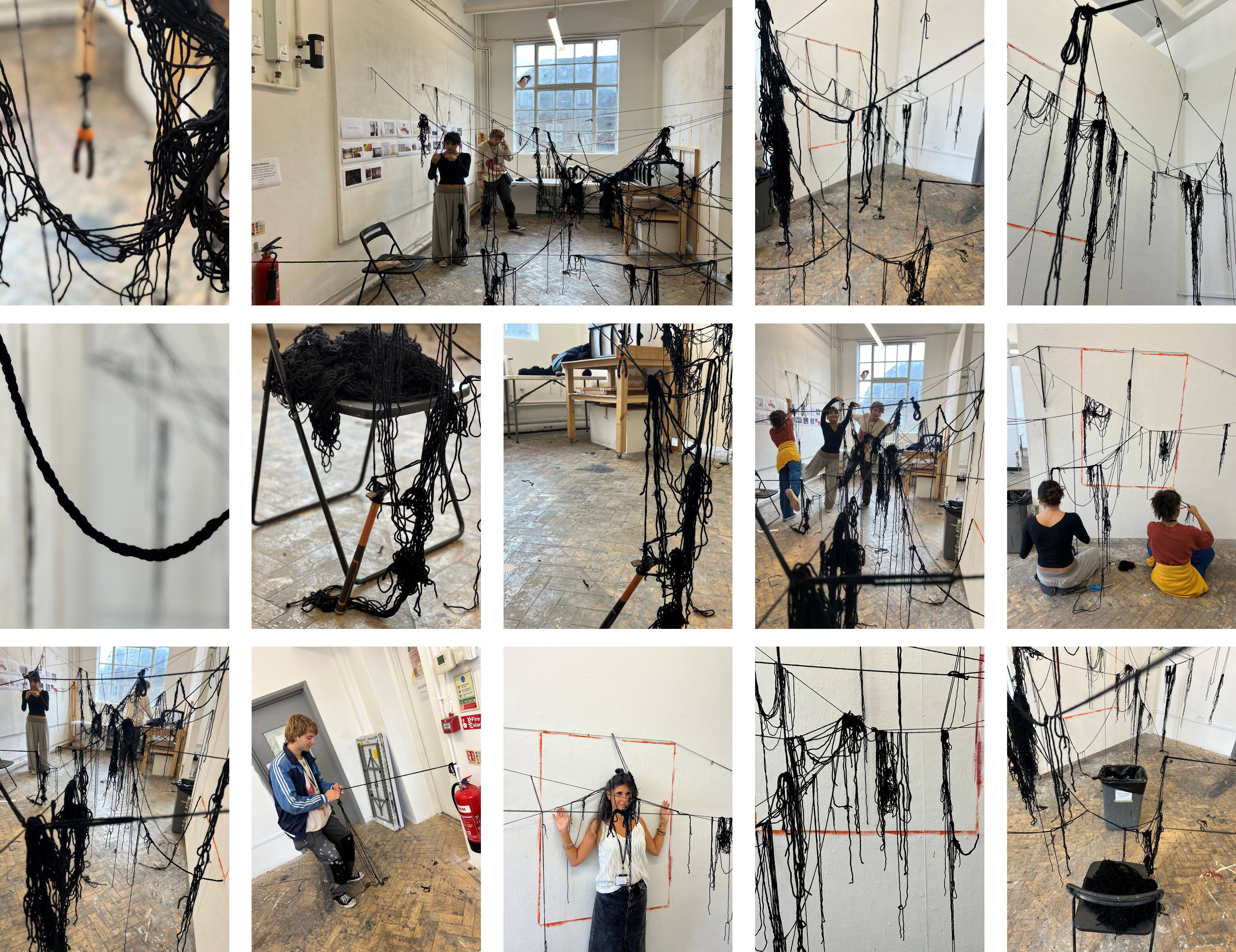
Working as a group, we used black wool to take our drawing off the page and into the room. We decided to work with what was already in the studio space i.e. nails on the walls, furniture, tools and existing marks on the walls, using sliding knots to allow the lines to move, making the installation interactive so that other students could step inside and change the structure. There was some sort of a logic within the chaos and the installation was never really finished.
Rather than starting with a fixed outcome, we responded to the space and to each other’s ideas, allowing the installation to develop as we worked.
What did I find challenging?
I found the exercises challenging because I was not in control and had to stop myself from overthinking what I was doing. I am used to making conscious decisions when I work, so allowing my senses, movement and instinct to lead rather than my brain felt quite unfamiliar, even uncomfortable at first but somehow freeing.
OUTCOME
The final outcome was an interactive installation that could continue to change as people moved through and interacted with it.
My interpretation
Looking at the four installations together, I started to see an unexpected story running through them. I saw a chasm or black hole, followed by life beginning again, then a black widow consuming everything, and finally our section as a kind of Big Bang full of possibilities. None of this was planned, which I think is what made it interesting.
REFLECTION
What did I think that I may have learned from the project?
I think I learned to have more fun with the process and be less self conscious about the outcome. Not everything has to be planned all the time or even perfect, sometimes experimenting, making mistakes and seeing what happens can lead somewhere much more interesting with more practice.
In some ways, I had fun working on the installation despite not knowing what would be the outcome. Not everything has to be planned or perfect. To me, the four separate installations unintentionally seemed to create a story when viewed together. It reconfirmed that ideas and meanings can emerge from the work afterwards, even when they were not part of the original plan.
I also realised that I tend to look for a solution quite quickly. This project showed me that sometimes I need to trust the process for longer and allow the work itself to influence where I go next.
Are there materials / techniques / processes / approaches from the project that you would like to investigate further?
Although I have enjoyed the experience, I am not sure this is an approach I am keen to develop further. It definitely made me think differently about drawing, but installation and working so freely with materials is probably not where my main interests lie. I would, however, like to take some of that freedom and spontaneity into my own work.
What would I do differently if I had to do the project again?
Although I understood the theory from my research, putting it into practice gave me a different perspective. Looking back, I think my approach was quite basic, so I would try to be more creative and experimental and push the ideas further rather than settling on my first response.
Did I document the work in progress and / or once complete?
I photographed the different drawing exercises as well as the development of the installation and the final piece. Photographing us interacting with it helped capture how the installation could change rather than being a fixed final piece.
RESEARCH & REFERENCES
Anastasi, W. (1968) Subway Drawing. [Graphite on paper]. Museum of Modern Art, New York. Available at: MoMA Collection
Grzymala, M. (2010) Raumzeichnung (Spatial Drawing). [Black adhesive tape installation]. Available at: This Is Colossal Features
Hansen, H. (2013) Emptied Gestures. [Charcoal on paper, Performance artwork]. Available at: Studio Heather Hansen Official
Kandinsky, W. (1911) Impression III (Concert). [Oil on canvas]. Städtische Galerie im Lenbachhaus, Munich. Available at: Wassily Kandinsky Complete Works
Knowles, T. (2005) Tree Drawing - Weeping Willow. [Ink on paper via wind-assisted tree movement]. Available at: Tim Knowles Archive
LeWitt, S. (1971) Wall Drawing #118. [Colored pencil on wall installation]. Art Institute of Chicago, Chicago. Available at: Art Institute of Chicago Collection
Namuth, H. (1950) Jackson Pollock painting in his studio. [Photograph]. Available at: The Metropolitan Museum of Art
Pollock, J. (1950) Autumn Rhythm (Number 30). [Enamel on canvas]. Metropolitan Museum of Art, New York. Available at: The Metropolitan Museum of Art Collection
Sandback, F. (1977) Untitled (Sculpture in Three Parts). [Acrylic yarn installation]. Available at: Dia Art Foundation Past Programs
Twombly, C. (1970) Untitled (Bolsena). [Oil-based house paint and crayon on canvas]. Museum of Modern Art, New York. Available at: MoMA Collection
Wright, R. (2009) Untitled. [Gold leaf on wall installation]. Tate Britain, London. Available at: Tate Britain Exhibition Archive